





Eye For Film >> Movies >> Thunderbirds Double Bill (1965) Film Review


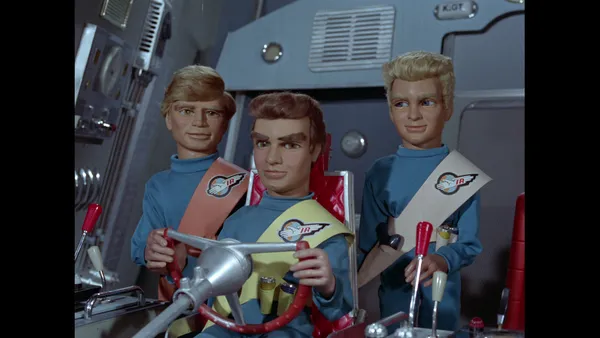

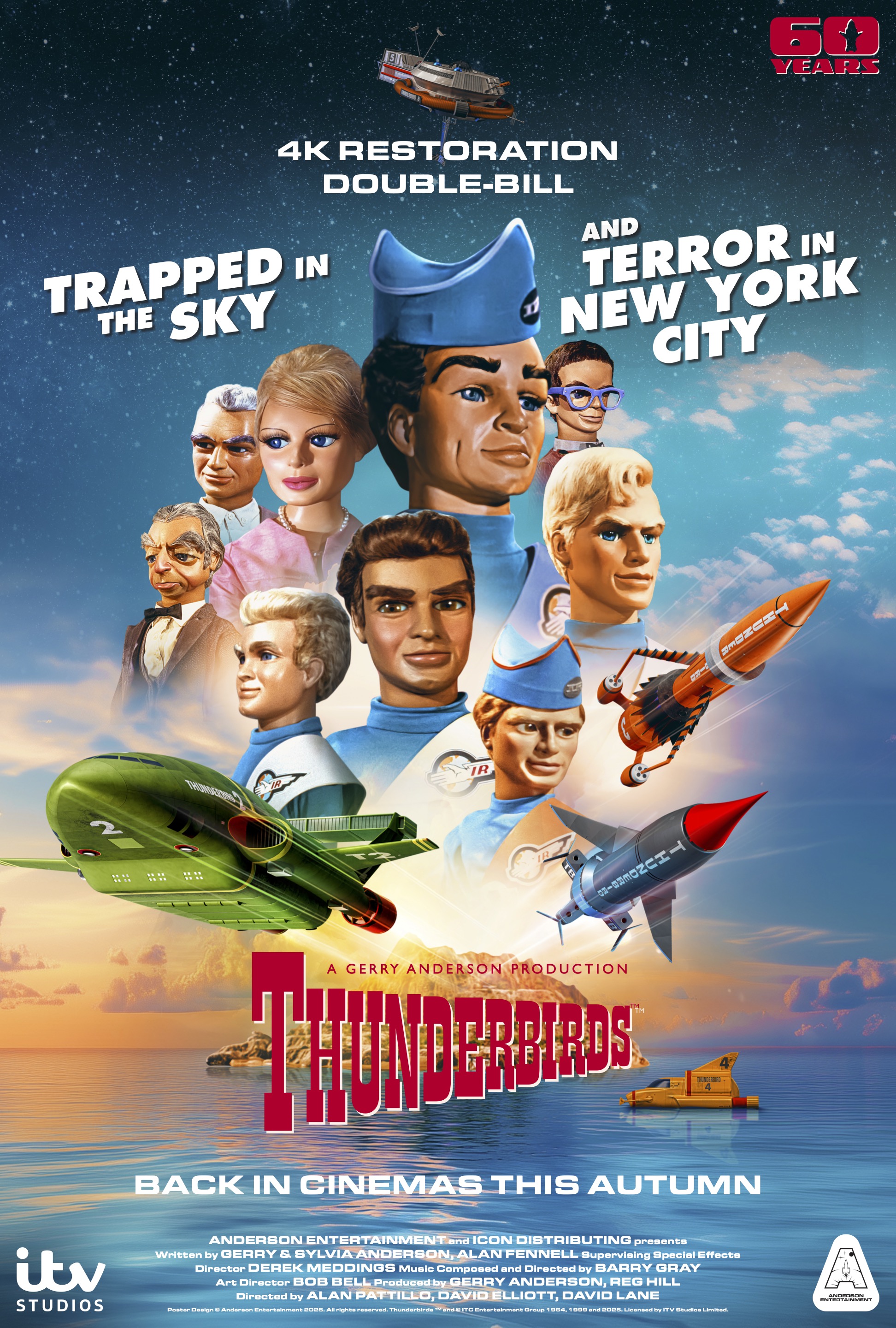
It has been 60 years since the brave men of the Tracy family took to the skies, the sea and space in their determined effort to prevent disasters and save lives around the world. in honour of their efforts, two episodes of the series depicting their efforts have been restored in glorious 4K, strings and all, for a big screen outing which will let fans enjoy them as never before. What all this will mean to newcomers is anyone’s guess, but if you’ve never dabbled in supermarionation, there couldn’t be a better time to try.
Playing back to back, Trapped In The Sky and Terror In New York City provide an opportunity to see the bold puppet team take on two very different kinds of emergency. The first, which also has the distinction of being the first episode ever broadcast, sees recurring villain the Hood place a bomb aboard an high profile experimental aircraft in a deliberate attempt to draw out the newly established International Rescue so that he can learn its secrets by, um, photographing the outside of one of its vessels (a scheme which likely seemed more meaningful back in the day when military bodies on both sides of the Cold War were absurdly paranoid about such things). The second, Episode 13 of the first series and a longstanding fan favourite, has its action divided between an unfortunate encounter which damages Thunderbird 2, and a bizarre attempt to move the Empire State Building (yes, you read that right) which, not unsurprisingly, goes wrong, leaving the team as the only hope of rescue for TV presenter and cameraman trapped beneath thousands of tons of wreckage.
Introduced by what remains one of the best theme tunes in the history of television, and with a helpful sequence that introduces the main characters and their roles, Thunderbirds promises a lot but struggles to maintain that dynamism throughout, with some long slow stretches which one really needs to be an engineering nerd like Gerry Anderson to appreciate. In other areas, scientific knowledge is distinctly unhelpful. When it emerges that the troubled plane can’t stay in the air because its radiation shielding will fail, no-one explains why it can’t just fly at a lower altitude. When they think they have no option but to attempt a landing which might result in a nuclear explosion, air traffic control staff direct it not to a remote airfield but to London.
Everything is measured in imperial units which, given that they differ in size between countries (for instance, a UK ton weighs more than a US ton) seems to be asking for trouble when operating internationally. In one scene, a problem is solved in a ‘harmless’ way which involves blasting people with x-rays. Lots of people smoke. Lower class people know their place. Wealthy white patriarch Jeff Tracy, hanging out on his private island, praises simpering Asian servant Kyrano for his loyalty. Lady Penelope, a charming but, as viewers will see here, casually violent English aristocrat, makes it clear that although he operates outside the law, Jeff has a tacit understanding with the British establishment to fall back on.
There are some great action set pieces. Today, most of these stunts would be done by CGI, and the aeroplane-boarding stunts would be done by Tom Cruise, but here it’s all puppetry, cleverly shot to work around the awkward bits where the strings get in the way. Despite the obvious artificiality of it all, Gerry and Sylvia Anderson succeed in generating tension. There’s a careful balance between real thrills and the inescapable comedy of these situations. This is managed by way of an ineffable sense of cool. Though they contain their share of camp moments, the episodes are played absolutely straight, with absolute confidence. The model work, for all its ingenuity, sometimes looks silly – all the more so on a big screen where it’s easier to see what things are made of – but it’s never short on style.
For all its flaws, Thunderbirds was seen as progressive in its time, both socially and technologically; and though the Andersons’ dream of a future full of puppet-based programmes never quite came true, their work has stood the test of time pretty well. It’s worth bearing with it through the slow stretches for its flashes of brilliance, and to admire the sheer creativity at work. These two episodes work together well and show it at its best.
Reviewed on: 20 Sep 2025



Director: Alan Pattillo, David Elliott, David Lane
Writer: Gerry Anderson, Sylvia Anderson, Alan Fennell
Starring: Sylvia Anderson, Ray Barrett, Peter Dyneley, Christine Finn, David Graham, Shane Rimmer, David Holliday, Matt Zimmerman
Year: 1965
Runtime: 111 minutes
Country: UK
Festivals:
Search database:
